

Kosmo NewsSupermoon
December 2026 Supermoon: The Last One of the Year
The 24 December 2026 full Moon is the last supermoon of the year and the closest full Moon of 2026. Exact time, distance and viewing tips.
By KosmoHow Kosmo makes its readings
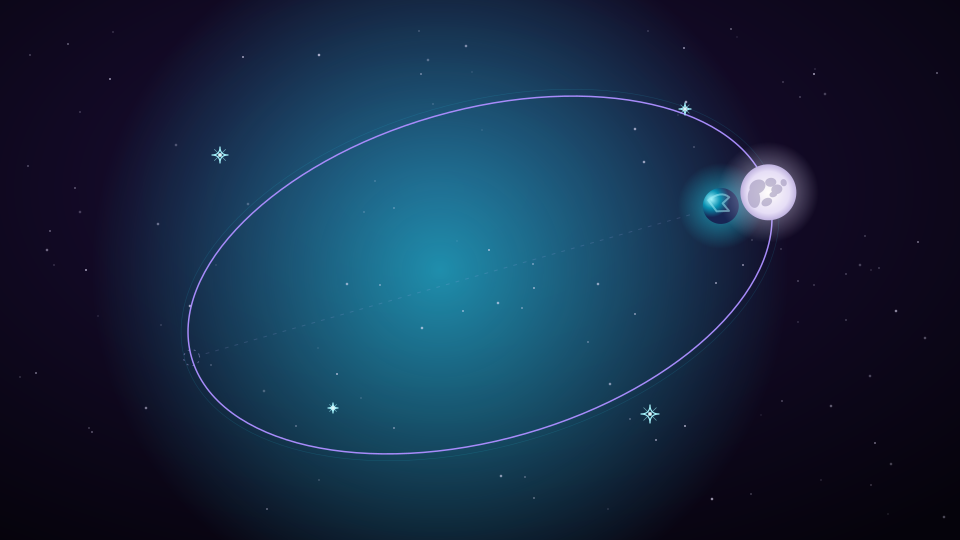
The full Moon of 24 December 2026, exact at 01:28 UTC according to the U.S. Naval Observatory, is the last supermoon of 2026 and the second of three in a row. In the Americas it is full on the evening of 23 December. At about 356,700 km from Earth, it is also the closest full Moon of the year.
When to see it
In the Americas the exact full Moon falls on the evening of Wednesday, 23 December: 19:28 in Costa Rica and Mexico City, 20:28 in New York and 17:28 in Los Angeles. In Europe and Africa it falls in the early hours of Thursday, 24 December, and in Asia and Australia in the morning or around midday of the 24th. Wherever you are, look east around sunset on 23 or 24 December to watch the Moon rise.
Why it is the closest of the year
Perigee, the Moon’s nearest point on this orbit, comes at 08:32 UTC on 24 December, only about 7 hours after full Moon, at about 356,600 km. When full Moon and perigee almost coincide, the full Moon is about as close as it gets. Kosmo compared every full Moon of 2026 with its chart engine and checked this one against NASA JPL Horizons: none comes closer.
| Full Moon (UTC) | Distance from Earth | Note |
|---|---|---|
| Oct 26, 2026, 04:12 UTC | 368,900 km | — |
| Nov 24, 2026, 14:53 UTC | 360,800 km | Supermoon |
| Dec 24, 2026, 01:28 UTC | 356,700 km | Supermoon, closest full Moon of 2026 |
| Jan 22, 2027, 12:17 UTC | 357,600 km | Supermoon, closest full Moon of 2027 |
NASA notes that the closest full Moons can look up to 14 percent bigger and 30 percent brighter than the year’s faintest one, and that supermoons can bring slightly higher tides. Its November skywatching tips describe the full Moons of November, December and January as three supermoons in a row.
Viewing and photo tips
- In the Northern Hemisphere, December’s full Moon rides high and stays up almost all night.
- In the Southern Hemisphere it is a short summer night and the Moon stays lower in the sky.
- Dress warmly where it is winter and let your eyes adjust; the bright Moon will hide faint stars.
- Photograph the Moon near the horizon with a landmark for scale, then again when it is high, to see the Moon illusion fade.
A note on astrology
Astrologically, this full Moon falls at about 2° Cancer, opposite the Sun at 2° Capricorn, just after the solstice. Cancer is linked with home, family and emotional safety; Capricorn with responsibility and long-term goals. Astrologers read the pairing as a balance between caring for people and caring for plans, a theme many people meet at the end of the year anyway. Like every astrological reading, it is a reflection, not a prediction.
Timing note: NASA’s supermoon page gives 01:28 UTC for this full Moon, the same minute as the U.S. Naval Observatory.