

Supermoon: What It Is, How Big It Looks and the 2026–2027 Dates
By KosmoHow Kosmo makes its readings
A supermoon is a full Moon that happens when the Moon is near perigee, the closest point of its slightly oval orbit around Earth. NASA says such a Moon can look up to 14 percent bigger and 30 percent brighter than the year’s faintest full Moon, though the size difference is hard to notice by eye. NASA’s supermoon page lists the full Moons of 24 November and 24 December 2026.
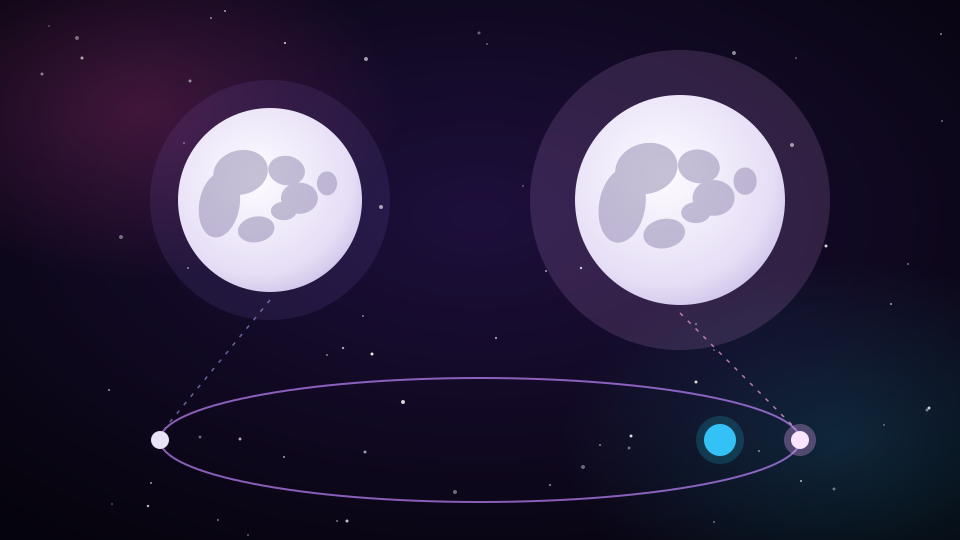
Why some full Moons are closer
The Moon’s orbit is an ellipse. In each circuit of about 27 days, it reaches perigee, typically around 363,300 km from Earth, and apogee, around 405,500 km away; the exact distances change from orbit to orbit. A full Moon can fall anywhere along that path, so most full Moons are neither especially near nor especially far.
“Supermoon” is not an official astronomical term. NASA describes it as a full Moon that comes within at least 90 percent of perigee, which usually gives three or four supermoons a year, one after another. Other sources draw the line differently, so supermoon lists do not always match.
Full Moon distances, late 2026 and 2027
| Full Moon (UTC) | Distance | Note |
|---|---|---|
| Nov 24, 2026, 14:53 UTC | 360,800 km | Supermoon on NASA’s list |
| Dec 24, 2026, 01:28 UTC | 356,700 km | Supermoon on NASA’s list and the closest in this table |
| Jan 22, 2027, 12:17 UTC | 357,600 km | Closest full Moon of 2027 |
| Feb 20, 2027, 23:23 UTC | 363,300 km | — |
| Mar 22, 2027, 10:44 UTC | 372,500 km | — |
| Apr 20, 2027, 22:27 UTC | 383,400 km | — |
| May 20, 2027, 10:59 UTC | 393,900 km | — |
| Jun 19, 2027, 00:44 UTC | 402,000 km | — |
| Jul 18, 2027, 15:45 UTC | 406,000 km | Farthest full Moon of 2027 |
| Aug 17, 2027, 07:29 UTC | 405,100 km | — |
| Sep 15, 2027, 23:03 UTC | 399,400 km | — |
| Oct 15, 2027, 13:47 UTC | 389,900 km | — |
| Nov 14, 2027, 03:26 UTC | 378,800 km | — |
| Dec 13, 2027, 16:09 UTC | 368,100 km | — |
The 22 January 2027 full Moon is closer than the 24 November 2026 supermoon on NASA’s list, so most supermoon lists will include it too. The full Moon of 18 July 2027, the farthest of the year, is sometimes nicknamed a micromoon.
How much bigger does it really look?
Side by side, as in the illustration, the difference between the nearest and farthest full Moons is clear. In the real sky there is nothing to compare it with, so most people cannot tell a supermoon by size alone. The extra brightness is easier to notice on a clear night.
A supermoon low on the horizon can look enormous, but that is mostly the Moon illusion, which makes any rising Moon seem larger. NASA notes that a supermoon can also bring higher tides than usual.
Supermoon, blood moon or blue moon?
- Supermoon: a full Moon near perigee. It looks slightly bigger and brighter, not a different colour.
- Blood moon: a total lunar eclipse, when Earth’s shadow turns the Moon reddish. It can coincide with a supermoon, but most supermoons are not eclipses.
- Blue moon: a calendar name, usually for the second full Moon in one calendar month. It does not look blue.
Supermoons in astrology
This is optional symbolism. Some astrologers read a supermoon as a full Moon with extra emphasis. The astronomy is simply a question of distance, so treat any meaning as a prompt for reflection, not a forecast.
Common questions
Is a supermoon dangerous?
No. It is the same Moon in a closer part of its orbit. Tides can run a little higher than usual.
Do I need equipment to see it?
No. Look east around sunset on the night of the full Moon; any clear view of the horizon works.
Why do supermoon lists disagree?
Because the term is informal. Sites use different distance limits, so a full Moon near the edge may appear on one list and not on another.