

Kosmo NewsSolstice
December Solstice 2026: Exact Time, Shortest and Longest Day
The December solstice is at 20:50 UTC on 21 December 2026, already 22 December in much of Asia and Oceania. The shortest day north, the longest south, and why.
By KosmoHow Kosmo makes its readings
Dates and sky positions are calculated from astronomy; meanings come from symbolic tradition.
Short answer: the December solstice happens at 20:50 UTC on 21 December 2026. It is a single instant for the whole planet, so the local date depends on your time zone: it is still 21 December across the Americas, Europe and Africa, but already 22 December in much of Asia and in Oceania. It brings the shortest day of the year in the Northern Hemisphere and the longest in the Southern Hemisphere. In Western astrology the same moment marks the start of Capricorn season.
When is the December solstice?
| City | Local date and time |
|---|---|
| Los Angeles | 21 December, 12:50 |
| Mexico City | 21 December, 14:50 |
| New York | 21 December, 15:50 |
| São Paulo | 21 December, 17:50 |
| London | 21 December, 20:50 |
| Madrid | 21 December, 21:50 |
| Cairo | 21 December, 22:50 |
| Moscow | 21 December, 23:50 |
| Dubai | 22 December, 00:50 |
| New Delhi | 22 December, 02:20 |
| Beijing | 22 December, 04:50 |
| Tokyo | 22 December, 05:50 |
| Sydney | 22 December, 07:50 |
| Auckland | 22 December, 09:50 |
The website timeanddate.com and the French national ephemeris service, IMCCE, both give 20:50 UTC; IMCCE computes it to the second, at 20:50:15. Because the solstice is an instant rather than a whole day, the calendar day on which it falls where you live is your solstice day: 21 December in most of the world, 22 December in places more than about three hours ahead of UTC.
What actually happens
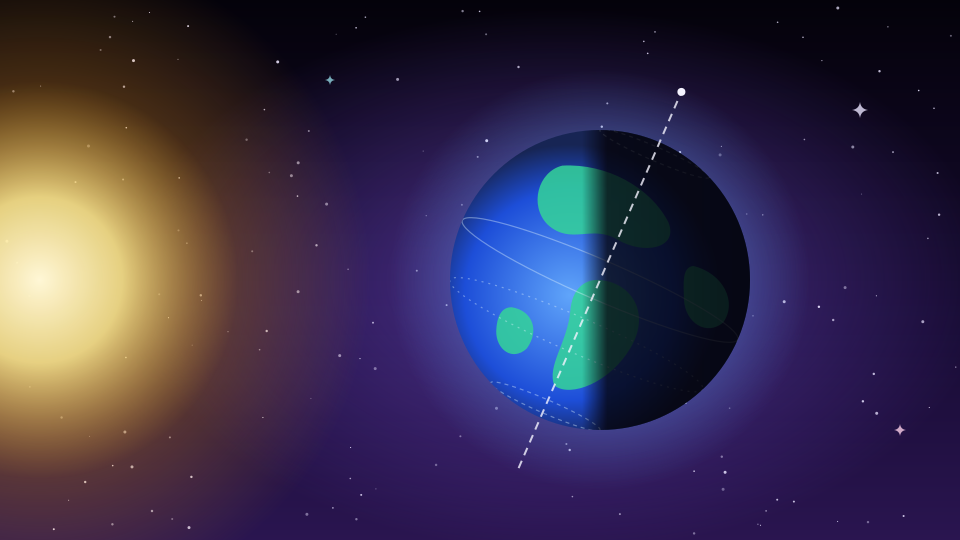
Earth’s axis is tilted by about 23.4 degrees from the perpendicular to the plane of its orbit, an angle called the obliquity, and it keeps pointing the same way in space all year. At the December solstice the Southern Hemisphere is tipped most towards the Sun and the Northern Hemisphere most away from it. At noon the Sun stands directly overhead on the Tropic of Capricorn, its farthest point south, and then starts moving north again. The word solstice comes from Latin for the Sun standing still.
Distance has nothing to do with it. Earth reaches perihelion, its closest point to the Sun, in early January, so the northern winter actually happens while Earth is nearer the Sun. Seasons come from the tilt: how high the Sun climbs and how long it stays up.
Shortest day north, longest day south
- North of the equator, the solstice brings the shortest daylight of the year and the lowest midday Sun. North of the Arctic Circle the Sun does not rise at all.
- South of the equator it is the longest day of the year, and south of the Antarctic Circle the Sun does not set.
- Near the equator day length barely changes, staying close to 12 hours all year.
- The shortest day is not the day of the earliest sunset or the latest sunrise. In most places the earliest sunset comes a few days before the solstice and the latest sunrise some days after it.
Not the start of winter everywhere
The December solstice is often called the winter solstice, but that is true only in the north, where it marks the start of astronomical winter. In the Southern Hemisphere it is the summer solstice. Many weather services also use meteorological seasons that start on the first day of a month, so for them northern winter and southern summer already began on 1 December.
A solstice is also not an equinox. Day and night are roughly equal around the March and September equinoxes; the solstices mark the extremes, with the most unequal day and night of the year.
The solstice in astrology: Capricorn season
In the tropical zodiac used in Western astrology, the December solstice defines 0 degrees of Capricorn, so Capricorn season begins at the same instant, 20:50 UTC on 21 December, and Sagittarius season ends; our Sagittarius season guide covers the month before. This is a convention tied to the seasons, not to the stars: at the solstice the Sun actually stands in the constellation Sagittarius, not Capricornus.
Astrologers traditionally associate Capricorn with structure, patience, responsibility and long-term goals, which is why many people treat the solstice as a moment to look back on the year and plan the next. These are symbolic themes, not forecasts. Your own sign dates and full birth chart say more about you than any single season.
Frequently asked questions
What time is the December solstice in 2026?
20:50 UTC on 21 December 2026. Add or subtract your time zone’s offset; in places more than about three hours ahead of UTC the local date is already 22 December.
Is the solstice the shortest day everywhere?
No. It is the shortest day in the Northern Hemisphere and the longest in the Southern Hemisphere. Near the equator the difference is small.
Is Earth farthest from the Sun at the December solstice?
No, it is nearly the opposite. Earth reaches perihelion, its closest point to the Sun, in early January. Seasons are caused by the tilt of Earth’s axis, not by distance.
Does the solstice change my zodiac sign?
No. Your Sun sign depends on your birth date and time. The solstice simply marks the boundary between Sagittarius and Capricorn in the tropical zodiac, so people born close to it should check their exact birth time.
Timing note: timeanddate.com gives 20:50 UTC and the IMCCE ephemeris 20:50:15 UTC; Kosmo’s chart engine, Astronomy Engine, agrees to the minute. Local times in the table use the IANA time-zone database with the clocks in use on 21 December 2026.
Sources
https://kosmoapp.com/new/news/december-solstice-2026