

Kosmo NewsMeteor shower
Geminids 2026: Peak Dates and How to Watch
The Geminids peak on the night of 13–14 December 2026, with the Moon setting in the evening. When to watch, what a ZHR of 150 means and where the name comes from.
By KosmoHow Kosmo makes its readings
Dates and sky positions are calculated from astronomy; meanings come from symbolic tradition.
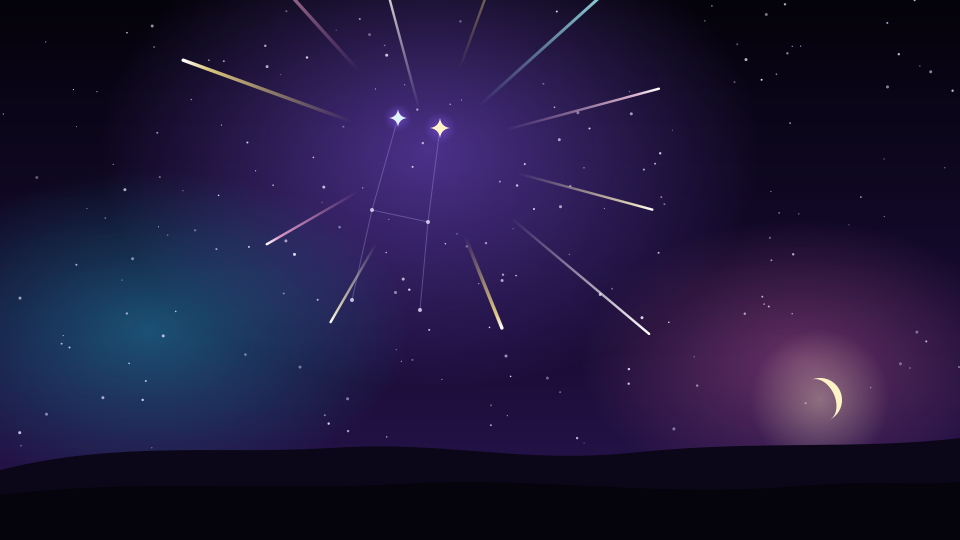
Short answer: the Geminid meteor shower is active from 4 to 20 December 2026, and the night of 13–14 December is the main one to watch. The International Meteor Organization (IMO) centres the broad maximum on 14 December at about 14:00 UTC, with a zenithal hourly rate (ZHR) of about 150. That is a modelled figure for one observer under a perfect dark sky with the radiant overhead, not a promised count: NASA expects 40 to 50 meteors an hour under typical dark skies. The crescent Moon sets in the evening, leaving the rest of the night dark.
Key dates
| Date or time (UTC) | What happens |
|---|---|
| Dec 4, 2026 | The shower becomes active |
| Dec 9, 2026, 00:52 UTC | New Moon |
| Dec 13, 2026, 21:00 UTC | Start of the window in which the maxima of the past two decades fell |
| Dec 14, 2026, 14:00 UTC | Centre of the broad maximum calculated by the IMO, ZHR about 150 (ideal conditions) |
| Dec 14, 2026, 18:00 UTC | End of the window of recent maxima |
| Dec 20, 2026 | The shower ends |
When to watch
The Geminid maximum is broad. The IMO notes rates of 100 or more lasting roughly 10 to 12 hours, and over the past two decades the peak has always fallen between 21:00 UTC on 13 December and 18:00 UTC on 14 December. So the exact minute in UTC matters less than when it is dark where you are and how high the radiant stands.
In the Americas, the hours before dawn on 14 December come closest to the maximum. In Europe and Africa, both the night of 13–14 December and the evening of 14 December are worth trying. In East Asia and Australia the 14:00 UTC centre falls during the night of 14–15 December, local time, so that night is the one to try there. If your first choice is cloudy, try the next night: rates stay good for about a day on either side.
How to watch
- Start in the evening and keep going late. From mid-northern latitudes the radiant rises around sunset, so Geminids appear from mid-evening, and rates grow as the radiant climbs. It stands highest around 2 a.m. local time.
- Find a dark spot away from streetlights, lie back and take in as much sky as you can. Allow 20 to 30 minutes for your eyes to adapt, and keep your phone screen off.
- Leave the telescope and binoculars at home: meteors are fast and appear all over the sky. Your eyes are the best tool.
- Do not stare only at the radiant. Meteors close to it look short, while those farther away leave longer trails.
- Dress for the night’s temperature, bring something to lie on and be patient: meteors come in bursts, with quiet minutes in between.
The Moon cooperates in 2026. It is new on 9 December, and on the peak night it is a waxing crescent, about a fifth lit, that sets in the evening a few hours after the Sun. After moonset the sky stays dark for the rest of the night, just as the radiant climbs.
Where in the world
The Geminids favour the Northern Hemisphere. Well north of the equator the radiant rises around sunset and is usefully high from the evening onwards. In the Southern Hemisphere it rises only around local midnight and stays low, so fewer meteors appear above the horizon and the hours after midnight are the ones to try. Kosmo does not forecast local weather or light pollution, which matter as much as the date.
Where the meteors come from
Most meteor showers come from comets, but the Geminids come from 3200 Phaethon, a small asteroid that takes about 1.4 years to orbit the Sun and may be a dead comet or a so-called rock comet. Every December Earth crosses the trail of debris it has left behind, and the grains burn up high in the atmosphere at about 35 km per second. That is slower than many showers, and Geminids are known for bright meteors, many of them yellowish.
Why the name: the constellation Gemini, not the sign
Meteor showers are named after the constellation where their radiant appears. Geminids seem to fly out of a point near Castor and Pollux, the twin stars of the constellation Gemini. They do not come from those distant stars: the radiant is a perspective effect of Earth moving through a stream of particles travelling in parallel, like snowflakes that seem to come from one point when you drive through snow.
The constellation Gemini and the zodiac sign Gemini are different things. The constellation is a region of sky; the tropical sign is a 30-degree slice of the ecliptic counted from the March equinox, as our star signs guide explains. In mid-December the Sun is in the tropical sign of Sagittarius, so the Geminids have nothing to do with Gemini season, which runs from late May to late June.
A note on astrology
Astrology gives the Geminids no traditional meaning, and a meteor shower does not change anyone’s horoscope, Geminis included. Watching one is simply a good reason to spend a dark night outside, ideally with someone else counting too. If you wonder how your signs get along, the compatibility checker is there when you are back indoors.
Frequently asked questions
What is the best night for the Geminids in 2026?
The night of 13–14 December for most of the world, with the night of 14–15 December a strong second choice and the first choice in East Asia and Australia. Start after dark and keep watching past midnight.
How many meteors will I see?
The IMO gives a ZHR of about 150, and NASA mentions about 120 an hour under perfect conditions. Under typical dark skies NASA expects 40 to 50 an hour, and near city lights you may see only a handful. The ZHR describes ideal conditions, not a guaranteed hourly count.
Do I need a telescope?
No. A telescope shows only a tiny patch of sky, while meteors can appear anywhere. Your eyes, a dark site and patience are all you need.
Can I see them from the Southern Hemisphere?
Yes, but fewer of them. The radiant rises around midnight and stays low, so watch in the hours after midnight.
Timing note: the IMO calendar centres the maximum on 14 December at 14:00 UTC and places the reliably reported maxima of the past two decades between 21:00 UTC on 13 December and 18:00 UTC on 14 December; NASA lists the peak night as 13–14 December. Kosmo gives no more precise minute, because the maximum is broad and the best time where you are depends on darkness and the height of the radiant.
Sources
Shall we watch it together?
https://kosmoapp.com/new/news/geminid-meteor-shower-2026