

Planetary Alignment: What a Planet Parade Really Is and How to See One
By KosmoHow Kosmo makes its readings
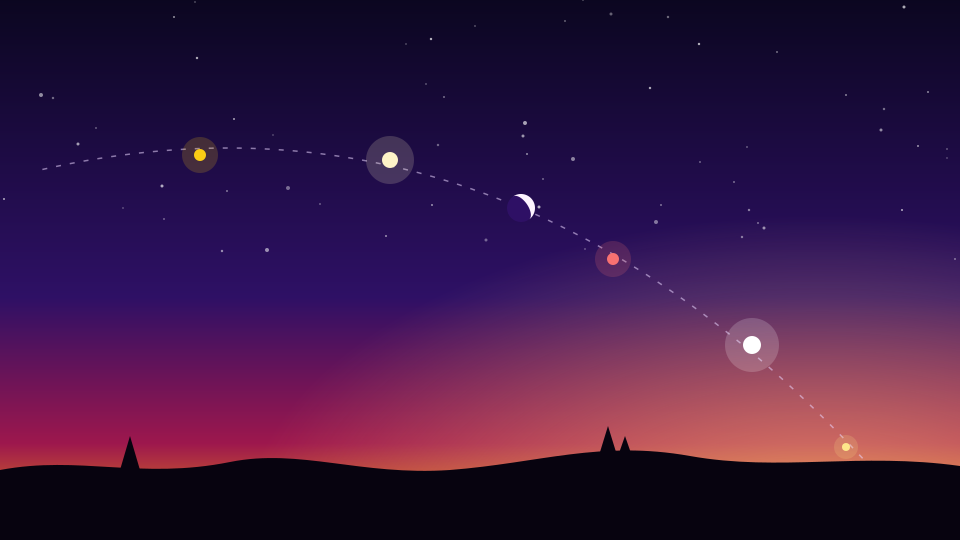
A planetary alignment, or planet parade, usually means several planets visible in the sky at the same time, strung along a curved line. They are not lined up in a straight row in space: the line is the ecliptic, our edge-on view of the flat plane the planets orbit in. NASA notes that “planet parade” is not a technical term, and that four or five planets seen together is uncommon but not rare.
Why the planets always appear along a line
The planets orbit the Sun in a fairly flat disc. Earth sits inside that disc, so we see it edge-on, and the Sun, Moon and planets all travel along the same band of sky, the ecliptic. On any night, the planets above the horizon therefore fall roughly along one arc. A parade simply means that several of them are away from the Sun’s glare at the same time.
Astronomers also use the word alignment for other events: a conjunction, when two objects appear close together, and an opposition, when an outer planet sits opposite the Sun in our sky and shines all night.
Which planets you can actually see
| Planet | Naked eye? | Viewing notes |
|---|---|---|
| Mercury | Yes, briefly | Low in twilight for a few days or weeks at a time, and easy to miss |
| Venus | Yes | The brightest planet, seen for a few months at a time after sunset or before sunrise |
| Mars | Yes | Reddish, and brightest around opposition |
| Jupiter | Yes | Very bright and steady; binoculars show its four largest moons |
| Saturn | Yes | Pale yellow; a small telescope shows the rings |
| Uranus | Barely | Needs dark skies and its exact position; a telescope is recommended |
| Neptune | No | Always needs a telescope |
Will you see it? Height, twilight and horizon
NASA advises that a planet should be at least a few degrees above the horizon to be seen, and ideally 10 degrees or more. Near the horizon, the atmosphere dims planets, and buildings or trees can block them. Parades are usually seen in twilight just after sunset or before sunrise, when the sky is still bright and the lowest planets are hardest to spot. A fist held at arm’s length covers roughly 10 degrees of sky, a handy way to judge height.
That is also why claims of six or seven planets in a row need care: Uranus and Neptune are not visible to the unaided eye, especially in twilight.
Upcoming multi-planet lineups
Planet parades last for weeks rather than a single night, because the planets move slowly across the sky. In its list of near-future viewing opportunities, NASA includes late October 2028, with five planets visible at once before sunrise, and late February 2034, with five after sunset, when Venus and Mercury will be challenging to observe. How much you see on any given morning still depends on your location, horizon and weather.
Planetary alignments in astrology
This is optional symbolism. Astrologers read several planets gathered in one sign, called a stellium, or a close conjunction as a concentrated theme. That reading is symbolic: an apparent lineup has no noticeable physical effect on Earth. To see which planets shared a sign when you were born, open your birth chart in the free report.
Common questions
Do the planets ever line up in a straight row in space?
Not all of them. Their orbits are slightly tilted and they move at different speeds, so what we see is an apparent grouping along the ecliptic, not a straight line in space.
Is a planet parade visible from everywhere?
No. Which planets you see, and how high they are, depends on your latitude, the date and time, and your horizon.
Can I see a planet parade from a city?
Often, yes, for the bright planets: Venus, Jupiter, Mars and Saturn shine through light pollution. Mercury needs a clear, low horizon.