

Kosmo NewsMeteor shower
Leonid Meteor Shower 2026: When to Watch and Why It Is Named After Leo
The Leonids peak around 17 November 2026, with a modelled ZHR of about 15 meteors an hour under ideal skies. When to watch, and what the name has to do with Leo.
By KosmoHow Kosmo makes its readings
Dates and sky positions are calculated from astronomy; meanings come from symbolic tradition.
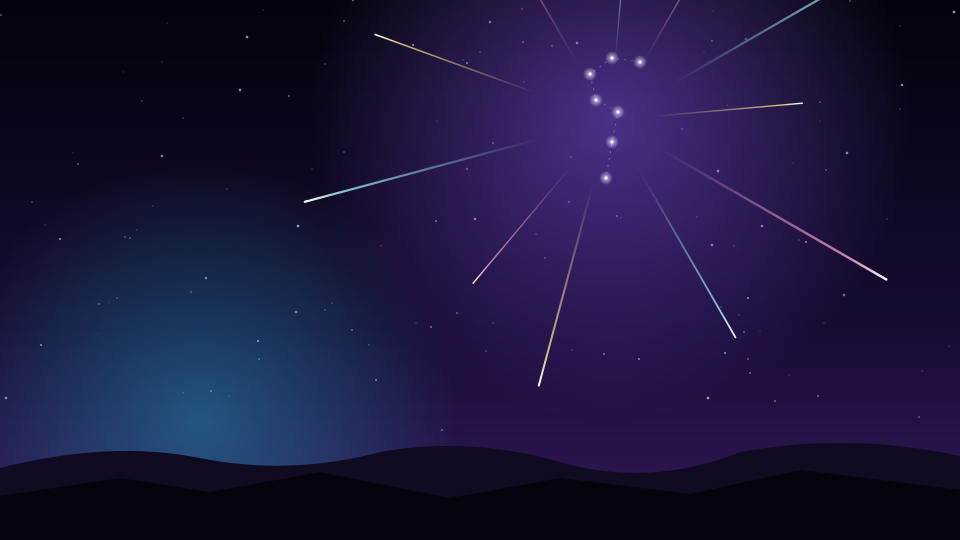
Short answer: the Leonid meteor shower is active from 6 to 30 November 2026 and peaks around 17 November. The International Meteor Organization (IMO) calculates the regular peak for 17 November at 23:45 UTC. The best time to watch is after midnight, local time, in the early mornings of 17 and 18 November. The IMO gives a zenithal hourly rate (ZHR) of about 15: a modelled figure for one observer under an ideal dark sky with the radiant overhead, not a guaranteed count. Real skies show fewer, and towns far fewer.
When to watch
| Date or time (UTC) | What happens |
|---|---|
| Nov 6, 2026 | The shower becomes active |
| Nov 17, 2026, 16:00 UTC | Alternative peak time from one model, ZHR about 15 (ideal conditions) |
| Nov 17, 2026, 23:45 UTC | Regular peak calculated by the IMO, ZHR about 15 (ideal conditions) |
| Nov 30, 2026 | The shower ends |
Meteor numbers rise and fall over a few days, so you do not need to catch the exact minute. NASA suggests the early hours of 17 and 18 November, after the Moon has set. Researchers also expect Earth to brush several thin, old dust trails between 17 and 19 November, but the IMO calendar notes they hold too little dust for an outburst. Expect a normal shower, not a storm.
How to watch
- Go out after midnight, local time. Leo rises late in the evening, and the higher it climbs before dawn, the more meteors you are likely to see.
- Find a spot away from streetlights, lie back and take in as much sky as you can. Give your eyes about 30 minutes to adjust to the dark, and keep your phone screen off.
- You do not need to stare at Leo. Meteors appear all over the sky, and NASA notes that the ones seen away from the radiant look longer.
- Leave the telescope at home: meteors are too fast and too spread out. Your eyes are the best tool.
- Dress warmly and be patient. Meteors come in irregular bursts, with quiet minutes in between.
The Moon helps this year. It reaches first quarter on 17 November, so it sets around midnight and leaves the darkest hours before dawn free of moonlight.
Where in the world
The Leonids can be seen from both hemispheres, but they favour the Northern Hemisphere, where Leo climbs higher before dawn. From southern mid-latitudes the radiant stays lower, so fewer meteors appear above the horizon. Local time matters more than the UTC peak: wherever you are, the hours between about midnight and the first light of dawn are the ones to try.
Where the meteors come from
Leonids are tiny grains of dust shed by comet 55P/Tempel-Tuttle, which takes about 33 years to orbit the Sun. Every November Earth crosses the comet’s dusty path, and the grains burn up high in the atmosphere at about 71 km per second, which makes them some of the fastest meteors of the year. Some leave bright fireballs or long, glowing trails.
Roughly every 33 years the Leonids can turn into a meteor storm, with a thousand or more meteors an hour. The last one came in 2002, and the comet is next due back near the Sun in 2031. Nothing like that is expected in 2026.
Why the name: the constellation Leo, not the sign
Meteor showers are named after the constellation where their radiant appears. Leonid meteors seem to fly out of a point in the constellation Leo, near the curved pattern of stars known as the Sickle. They are not coming from Leo’s stars: the radiant is a perspective effect, like snowflakes that seem to come from one point when you drive through snow.
The constellation Leo and the zodiac sign Leo are not the same thing. The constellation is a region of sky with official boundaries. The tropical sign Leo is a 30-degree slice of the ecliptic, counted from the March equinox. Because Earth’s axis slowly wobbles, signs and constellations have drifted apart by roughly one sign over two thousand years; our star signs guide explains why. In mid-November the Sun is in the tropical sign of Scorpio, so the Leonids have nothing to do with Leo season.
A note on astrology
Astrology gives the Leonids no traditional meaning, and a meteor shower does not change anyone’s horoscope, Leos included. If you enjoy a ritual, a clear, dark night is simply a good moment to slow down, look up and make a wish, which is what shooting stars have always been for.
Frequently asked questions
What is the best night for the Leonids in 2026?
Try the early morning of 17 November and again on 18 November, after midnight local time. If one is cloudy, the other is almost as good.
How many meteors will I see?
The IMO and NASA give a zenithal hourly rate (ZHR) of about 15. That is a modelled rate for one observer under a perfectly dark sky with the radiant directly overhead, not a promised maximum. Real counts are lower, often just a handful an hour, especially near city lights or while Leo is still low.
Will there be a meteor storm?
No. Storms happen only in some years close to the comet’s return, and the forecasts for 2026 point to normal activity.
Can I see them from the Southern Hemisphere?
Yes, but fewer of them. The radiant rises later and stays lower, so look in the last hours before dawn.
Timing note: the IMO gives the regular peak at 23:45 UTC on 17 November and an alternative model at 16:00 UTC the same day. In the Americas both fall during the day or evening of 17 November; in Europe, Africa and Asia they span the afternoon of 17 November to the morning of 18 November. Either way, the dark hours after midnight on both mornings are worth a try.
Sources
Shall we watch it together?
https://kosmoapp.com/new/news/leonid-meteor-shower-2026