

Kosmo NewsPlanet
Uranus at Opposition 2026: When and How to See It
Uranus reaches opposition on 25 November 2026, at magnitude 5.6 among the stars of Taurus. Why the full Moon matters and how to find it with binoculars.
By KosmoHow Kosmo makes its readings
Dates and sky positions are calculated from astronomy; meanings come from symbolic tradition.
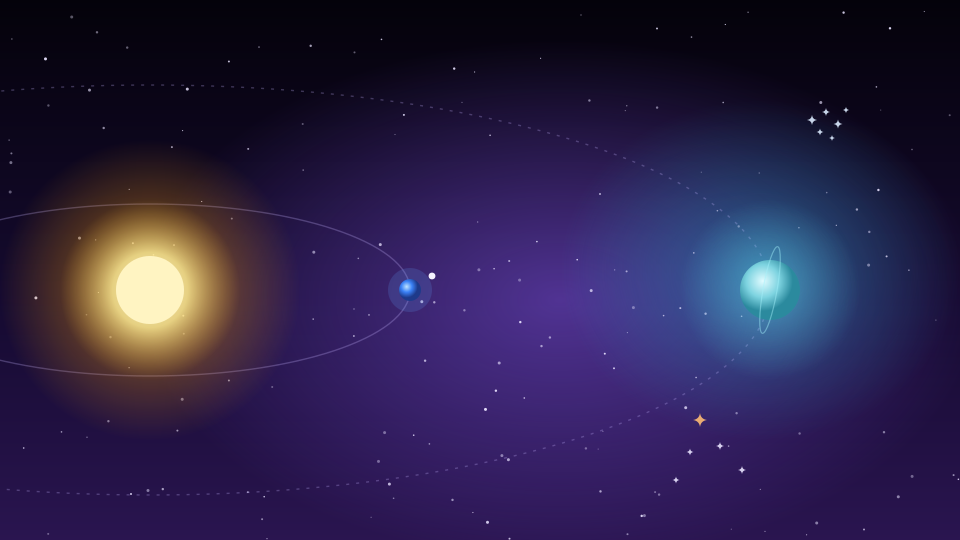
Short answer: Uranus reaches opposition on 25 November 2026. Earth then passes between the Sun and Uranus, so the planet rises around sunset, stays up all night and shines at its brightest of the year, about magnitude 5.6. That is still faint. Uranus sits in the constellation Taurus, between the Pleiades and the Hyades, and binoculars plus a star chart make it far easier to find. The catch this year is the Moon: the full Moon of 24 November shines in the same part of the sky, so the nights right around opposition are washed out, and the darker evenings of early December are often the better chance.
Key dates
| Date or time (UTC) | What happens |
|---|---|
| Nov 24, 2026, 14:53 UTC | Full Moon in the constellation Taurus, about 5 degrees from Uranus |
| Nov 25, 2026 | Uranus at opposition: up all night and at its brightest for the year, about magnitude 5.6 |
| Dec 1, 2026, 06:09 UTC | Last quarter Moon: from now on the first hours after dark are free of moonlight |
| Dec 9, 2026, 00:52 UTC | New Moon: the darkest nights of the period |
What opposition means
Opposition is a matter of geometry. Uranus takes about 84 years to circle the Sun, while Earth goes round once a year and keeps overtaking it. When Earth passes between the Sun and Uranus, the three line up with Earth in the middle, and from our point of view Uranus sits opposite the Sun in the sky. It rises in the east around sunset, climbs highest around midnight and sets around sunrise.
Opposition is not two things people often assume. Uranus does not cross in front of the Sun: it is on the far side of the sky from it. And opposition is not automatically the closest possible pass. Uranus’s distance changes little from year to year, and in 2026 its closest approach comes within a day of opposition, at nearly 2.8 billion kilometres. The practical gain is simply that the planet is up all night and a little brighter than at other times of year.
How to find Uranus
- Look towards Taurus. Uranus lies between the Pleiades, the small misty cluster also called the Seven Sisters, and the V-shaped Hyades around the orange star Aldebaran, about 6 degrees from the Pleiades.
- Use binoculars and a finder chart or planetarium app. At magnitude 5.6 Uranus is at the very edge of what eyes can see, and only under exceptionally dark skies, so for most people it is a binocular target.
- Expect a star-like point. Through binoculars Uranus looks like a faint star; a small telescope at high magnification shows a tiny blue-green disc, without surface detail.
- Confirm it over a few nights. Sketch or photograph the field and look again a few nights later: the point that has shifted against the background stars is the planet.
- Give your eyes time. Away from streetlights, let them adjust to the dark for about 20 minutes, and read your chart with a dim red light.
Why the opposition date is not the best night
The date of opposition does not guarantee the best view. The Moon is full on 24 November, a day before opposition, and it passes through Taurus close to Uranus, so the sky around the planet is flooded with moonlight that night and the next. Picking out a magnitude 5.6 point near a full Moon is hard even with binoculars.
Uranus barely changes in brightness over a few weeks, so there is no need to chase the exact date. As the Moon wanes it rises later each evening: after last quarter on 1 December the first hours after dark are moon-free, and around the new Moon of 9 December the whole night is dark. Those evenings, while Taurus is well up, are a good window. Kosmo cannot forecast your weather or how dark your local sky is, so check both before you go out.
Where in the world
How high Uranus climbs around opposition, and how many hours it is up, depends on your latitude and local horizon. From mid-northern latitudes Taurus climbs high in the southern sky around midnight. From the Southern Hemisphere it stays lower, in the northern sky, and the star patterns appear upside down compared with northern charts. Local time matters more than the date: the hours around local midnight put Uranus highest.
Constellation Taurus, zodiac sign Gemini
In the sky, Uranus is in the constellation Taurus. In the tropical zodiac used in Western astrology it is at about 4 degrees of Gemini. The two differ because signs are 30-degree slices of the ecliptic counted from the March equinox, while constellations are regions of sky with official boundaries, and the two have drifted apart over some two thousand years; our star signs guide explains why.
Astrologers also describe Uranus as retrograde at this time. From Earth it seems to drift slowly backwards against the stars from 11 September 2026 to 9 February 2027, a normal effect of Earth overtaking it, and opposition falls in the middle of that backwards stretch.
A note on astrology
In astrology, Uranus is associated with change, independence, surprise and new ideas, and its slow passage through Gemini is read as a long theme of curiosity, communication and technology rather than a one-night event. These are traditional meanings, not predictions, and an opposition does not change anyone’s birth chart. Kosmo’s report does not show Uranus; its birth chart reading covers your Sun and Moon, plus rising if you know your birth time.
Frequently asked questions
What date is Uranus at opposition in 2026?
25 November 2026 in Universal Time. In East Asia and Oceania the local date is already 26 November. The planet stays well placed for weeks on either side.
Can I see Uranus without binoculars?
Only just, and only under an exceptionally dark, moonless sky. At magnitude 5.6 it sits at the limit of naked-eye visibility, so binoculars are the practical tool.
Is opposition the same as closest approach?
Not exactly. Opposition is when Uranus is opposite the Sun in our sky, while the closest approach depends on the shape of both orbits. In 2026 they fall within a day of each other, so the difference is tiny.
When is the best night to look?
Any clear, dark night from late November to mid-December works. Right around opposition the full Moon is close by, so the moon-free early evenings after 1 December and the dark nights around 9 December are easier.
Timing note: different definitions of opposition, in ecliptic longitude or in right ascension, put the moment less than an hour apart, all late on 25 November UTC, so Kosmo gives the date rather than a minute. The magnitude and position come from the British Astronomical Association and the Astronomical Society of Edinburgh, Moon phases from the U.S. Naval Observatory, and the zodiac position and retrograde dates from Astronomy Engine.
Sources
Shall we watch it together?
https://kosmoapp.com/new/news/uranus-opposition-november-2026