

Kosmo NewsPlanet parade
November 2026 Planetary Alignment: How to See Four Planets Before Sunrise
Mercury, Venus, Mars and Jupiter share the dawn sky from about 13 to 22 November 2026. When and where to look, and why it is not a straight line.
By KosmoHow Kosmo makes its readings
Dates and sky positions are calculated from astronomy; meanings come from symbolic tradition.
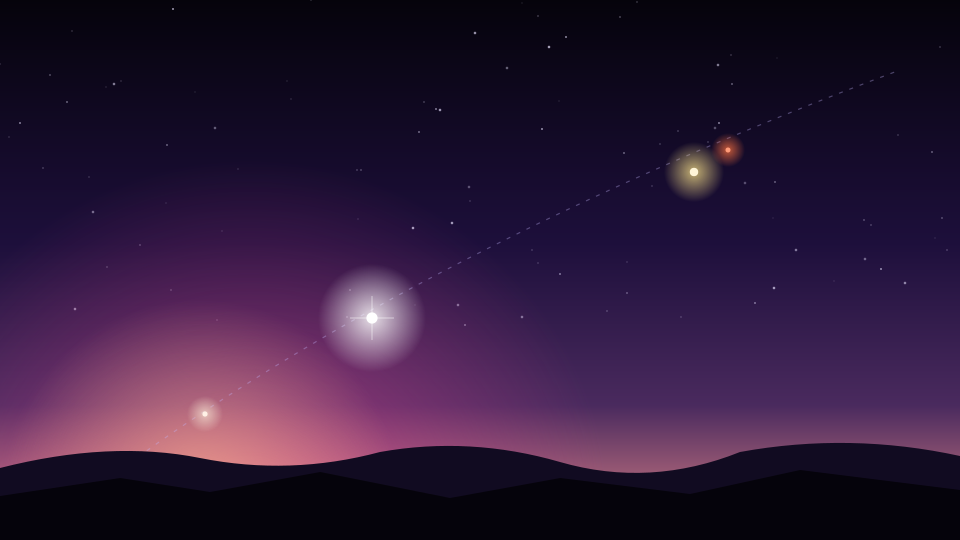
Short answer: from about 13 to 22 November 2026, Mercury, Venus, Mars and Jupiter can all be seen in the east before sunrise, strung along the path the planets follow across the sky. All four are visible without a telescope. Mercury is the hard one: it sits low in the brightening dawn, and the best mornings to catch it are 20 to 22 November, especially from the Northern Hemisphere.
When and where to look
Go out about an hour before sunrise and face east to southeast. Star Walk, which publishes a detailed observing guide for this event, notes that the line-up starts forming around 8 November, but Mercury is too low at first. From roughly 13 to 22 November all four can be found in the same dawn sky, weather and horizon permitting.
| Morning | What it is good for |
|---|---|
| Nov 14, 2026 | A more compact-looking group; Mercury still low |
| Nov 15, 2026 | Mars and Jupiter about 1.2 degrees apart, NASA’s highlight of the month |
| Nov 20, 2026 | Mercury at its greatest angle from the Sun, about 19.6 degrees, so higher and easier to spot |
| Nov 22, 2026 | One of the last good mornings for Mercury in this window |
There is no single worldwide clock time for this event. The right moment is local: after the sky has started to brighten, but before the Sun comes up. As examples, Star Walk’s suggested best times for 20 November are 06:10 in New York, 06:35 in London and 05:45 in Tokyo, each in local time.
How to find each planet
- Start higher in the southeast with Jupiter, the brightest point in that part of the sky, and the fainter reddish dot beside it, which is Mars. Both are in the constellation Leo.
- Lower and closer to the east, look for Venus. It is by far the brightest of the four and hard to miss.
- Last, scan low above the eastern horizon, below Venus and closer to where the Sun will rise, for Mercury: a small, steady point that fades as the sky brightens.
- Binoculars help you pick Mercury out of the twilight. Put them away before sunrise, and never point binoculars or a telescope at the Sun.
Here a flat, open view to the east matters more than a dark sky. Hills, trees, buildings and haze can hide Mercury while the other three are still easy to see.
Why it is not a straight line
Planets always appear near the ecliptic, the Sun’s yearly path across our sky, because they orbit in nearly the same plane. That is why they look roughly lined up. They do not form a perfect straight line, and they are not lined up in space: each one is at a different point in its own orbit, at very different distances from Earth. NASA calls these line-ups planet parades and stresses that they are a matter of perspective.
It is not a conjunction of all four planets either. A conjunction is when two bodies appear at their closest, like the Mars–Jupiter meeting of 15 and 16 November, which has its own story in Kosmo News. Together the four planets stretch across a wide piece of sky, so you may need to turn your head, or take a panorama, to see them all. Our guide to planet parades explains how often line-ups like this happen.
Northern and Southern Hemisphere
This line-up favours the Northern Hemisphere and the tropics. From southern mid-latitudes, such as Sydney, Cape Town or Buenos Aires, Star Walk finds that Mercury stays very low until the sky is already bright, so Venus, Mars and Jupiter are the realistic targets there. Closer to the equator the full set is easier. Clouds, a blocked horizon or city haze can hide Mercury anywhere, so treat it as a bonus.
What astrology reads into it
In astrology, a planet parade has no fixed meaning of its own; astrologers read each planet in its sign. In the tropical zodiac, Mercury is in Scorpio, Venus in Libra, and Mars and Jupiter together in Leo during this window. Some astrologers see a cluster like this as a moment when several areas of life ask for attention at once. That is symbolism layered on a real view, not a prediction: what you can check is the sky itself.
Frequently asked questions
Can I see it after sunset?
No, this is a morning event. Mars and Jupiter rise well before dawn, but Venus and Mercury only clear the horizon in the last hours before sunrise.
Do I need a telescope?
No. All four are bright enough for the naked eye. Binoculars make Mercury easier to find, and a small telescope can show Jupiter’s largest moons and the phase of Venus.
Is 14 or 20 November better?
If you want the planets in a tighter group, try 14 November. If your goal is to spot all four, including Mercury, aim for 20 to 22 November.
Will the Moon be in the way?
Hardly. The Moon is new on 9 November and at first quarter on 17 November, so during this window it shines in the evening and leaves the dawn sky dark.
Anything else to see while I am out?
Yes. The Leonid meteor shower peaks around 17 and 18 November, so keep an eye out for quick streaks of light. Kosmo News has a separate story on when to watch.
Timing note: dates refer to the morning sky in local time. Mercury’s greatest elongation, 19.6 degrees west of the Sun, falls on 20 November at about 23:30 UTC, which is already the morning of 21 November in much of Asia and Australia. Kosmo computed planet positions with Astronomy Engine and checked Mercury’s elongation against NASA JPL Horizons.
Sources
Shall we watch it together?
https://kosmoapp.com/new/news/planetary-alignment-november-2026