

Sky Calendar: Moon Phases, Meteor Showers and Sky Events
What is happening in the sky right now, and what is coming next. Moon phases, seasons and planet positions are calculated live; meteor shower peaks come from published estimates, each with its source.
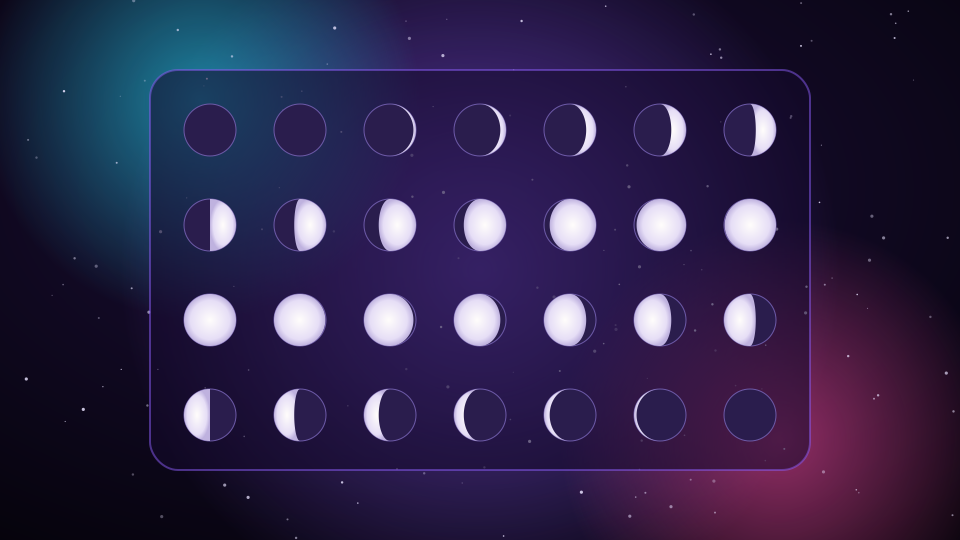
The sky right now
Tuesday, November 17, 2026 at 08:00 · Coordinated Universal Time (UTC)
The date, day boundaries and times follow this time zone. Nothing is sent or saved.
The Moon right now: Aquarius · First quarter · 49%
| Body | Sign | Degree | Motion |
|---|---|---|---|
| Sun | Scorpio | 24°59′ | — |
| Moon | Aquarius | 23°13′ | — |
| Mercury | Scorpio | 6°12′ | Direct |
| Venus | Libra | 23°05′ | Direct |
| Mars | Leo | 26°22′ | Direct |
| Jupiter | Leo | 25°58′ | Direct |
| Saturn | Aries | 8°25′ | Retrograde |
| Uranus | Gemini | 4°02′ | Retrograde |
| Neptune | Aries | 1°48′ | Retrograde |
Next Moon phases
- Next New Moon
- Your time: Wed, Dec 9, 00:52
- Next first quarter
- Your time: Tue, Nov 17, 11:48
- Next full Moon
- Your time: Tue, Nov 24, 14:53
- Next last quarter
- Your time: Tue, Dec 1, 06:09
Coming up in the next 90 days
All instants are stored in UTC; the local column converts them to your chosen time zone. Times in the second column follow the time zone you pick.
| Date and time (UTC) | Your time | Event | Basis | Status | Story |
|---|---|---|---|---|---|
| Tue, Nov 17, 11:48 | First quarter Moon | Calculated | Upcoming | — | |
| Tue, Nov 17, 23:45 | Leonid meteor shower peak | Published estimate | Upcoming | Read the story | |
| Sun, Nov 22, 07:23 | The Sun enters Sagittarius | Published time | Upcoming | Read the story | |
| Tue, Nov 24, 14:53 | Full Moon | Published time | Upcoming | Read the story | |
| — | Uranus at opposition | Date only (published) | Upcoming | Read the story | |
| Tue, Dec 1, 06:09 | Last quarter Moon | Calculated | Upcoming | — | |
| Wed, Dec 9, 00:52 | New Moon | Calculated | Upcoming | — | |
| about Thu, Dec 10, 23:20 | Saturn turns direct in Aries | Calculated | Upcoming | — | |
| about Sun, Dec 13, 01:00 | Jupiter turns retrograde in Leo | Calculated | Upcoming | — | |
| Mon, Dec 14, 14:00 | Geminid meteor shower peak | Published estimate | Upcoming | Read the story | |
| Thu, Dec 17, 05:43 | First quarter Moon | Calculated | Upcoming | — | |
| Mon, Dec 21, 20:50 | December solstice | Published time | Upcoming | Read the story | |
| Mon, Dec 21, 20:50 | The Sun enters Capricorn | Published time | Upcoming | Read the story | |
| Thu, Dec 24, 01:28 | Full Moon | Published time | Upcoming | Read the story | |
| Wed, Dec 30, 19:00 | Last quarter Moon | Calculated | Upcoming | — | |
| Thu, Jan 7, 20:25 | New Moon | Calculated | Upcoming | — | |
| Sun, Jan 10, 13:00 | Mars turns retrograde in Virgo | Published time | Upcoming | Read the story | |
| Fri, Jan 15, 20:35 | First quarter Moon | Calculated | Upcoming | — | |
| Wed, Jan 20, 07:30 | The Sun enters Aquarius | Calculated | Upcoming | — | |
| Fri, Jan 22, 12:17 | Full Moon | Calculated | Upcoming | — | |
| Fri, Jan 29, 10:56 | Last quarter Moon | Calculated | Upcoming | — | |
| Sat, Feb 6, 15:56 | New Moon | Calculated | Upcoming | — | |
| about Tue, Feb 9, 17:40 | Mercury turns retrograde in Pisces | Calculated | Upcoming | — | |
| Sun, Feb 14, 07:59 | First quarter Moon | Calculated | Upcoming | — |
No published meteor-shower estimates are registered after Dec 20, 2026. Calculated events continue automatically.
In the last 30 days
| Date and time (UTC) | Your time | Event | Basis | Status | Story |
|---|---|---|---|---|---|
| Sat, Nov 14, 00:20 | Venus turns direct in Libra | Published time | Happened | Read the story | |
| Fri, Nov 13, 15:50 | Mercury turns direct in Scorpio | Published time | Happened | Read the story | |
| Mon, Nov 9, 07:02 | New Moon | Calculated | Happened | — | |
| Sun, Nov 1, 20:28 | Last quarter Moon | Calculated | Happened | — | |
| Mon, Oct 26, 04:12 | Full Moon | Calculated | Happened | — | |
| about Sat, Oct 24, 07:20 | Mercury turns retrograde in Scorpio | Calculated | Happened | — | |
| Fri, Oct 23, 09:38 | The Sun enters Scorpio | Calculated | Happened | — | |
| Sun, Oct 18, 16:13 | First quarter Moon | Calculated | Happened | — |
Meteor showers
| Shower | Active | Peak (UTC) | ZHR | Source |
|---|---|---|---|---|
| Leonid meteor shower peakBest after local midnight in the early mornings of 17 and 18 November. | Nov 6, 2026 – Nov 30, 2026 | Nov 17, 2026, 23:45 UTC | 15 | International Meteor Organization — Meteor Shower Calendar 2026NASA — Leonids |
| Geminid meteor shower peakIn the Americas, the hours before dawn on 14 December; in Europe and Africa, the night of 13–14 December and the evening of 14 December; in East Asia and Australia, the night of 14–15 December. | Dec 4, 2026 – Dec 20, 2026 | Dec 14, 2026, 14:00 UTC | 150 | International Meteor Organization — Meteor Shower Calendar 2026NASA — Geminids |
Uranus rises around sunset and is up all night; binoculars and a star chart help. Kosmo’s source gives the date, not a time.
How to read this calendar
- Weather is not part of this calendar: clouds, haze and light pollution decide what you actually see.
- Visibility depends on your latitude and local horizon. A meteor shower’s radiant can stay low in parts of the Southern Hemisphere, so the best hours differ from place to place.
- Meteor shower peaks are published estimates for a broad maximum, not exact moments, and the zenithal hourly rate (ZHR) is an ideal-sky model, not a promised count.
- A solstice or equinox is one instant worldwide; whether a solstice brings the longest or the shortest day depends on your hemisphere.
- Astrological signs here are the tropical zodiac, not the constellations you see: the Geminids are named after the constellation Gemini, not after Gemini season.
Method and sources
Moon phases, equinoxes and solstices, the Sun’s sign changes, planet stations and positions are calculated with Astronomy Engine (geocentric apparent positions, tropical zodiac), the same engine as Kosmo’s report.
When a Kosmo News story covers the same event, the calendar shows the time published in that story, taken from the U.S. Naval Observatory, IMCCE or the International Meteor Organization; calculated times agree with them to within a few minutes.
Planet stations are slow turning points, so their times are rounded to the nearest ten minutes.
Meteor shower dates come from the International Meteor Organization’s 2026 calendar, as reported in Kosmo News; Kosmo does not calculate them.
Sources
Related stories and guides
- November 2026 Planetary Alignment: How to See Four Planets Before Sunrise
- Leonid Meteor Shower 2026: When to Watch and Why It Is Named After Leo
- Sagittarius Season 2026: When It Starts and What It Represents
- Supermoon on November 24, 2026: When and How to See It
- Full Moon in Gemini, November 2026: Dates and Astrological Meaning
- Uranus at Opposition 2026: When and How to See It
- Moon Phases 2027: New Moon and Full Moon Calendar
- Full Moon Dates 2026–2027: When Is the Next Full Moon?
- New Moon Dates for 2026 and 2027, and Why You Can’t See It
- Supermoon: What It Is, How Big It Looks and the 2026–2027 Dates
- Eclipse Calendar 2027: Solar and Lunar Dates
- Planetary Alignment: What a Planet Parade Is and How to See One
- Mercury Retrograde 2027: Dates and What Retrograde Means
- Birth Moon Phase vs Moon Sign: What’s the Difference?
- Sky events
Curious what the sky means for you? Your weekly love horoscope is calculated from your birth date.
Your aura, angel number and birth chart are part of Kosmo Plus. Your weekly love horoscope stays free.
https://kosmoapp.com/new/sky-calendar